
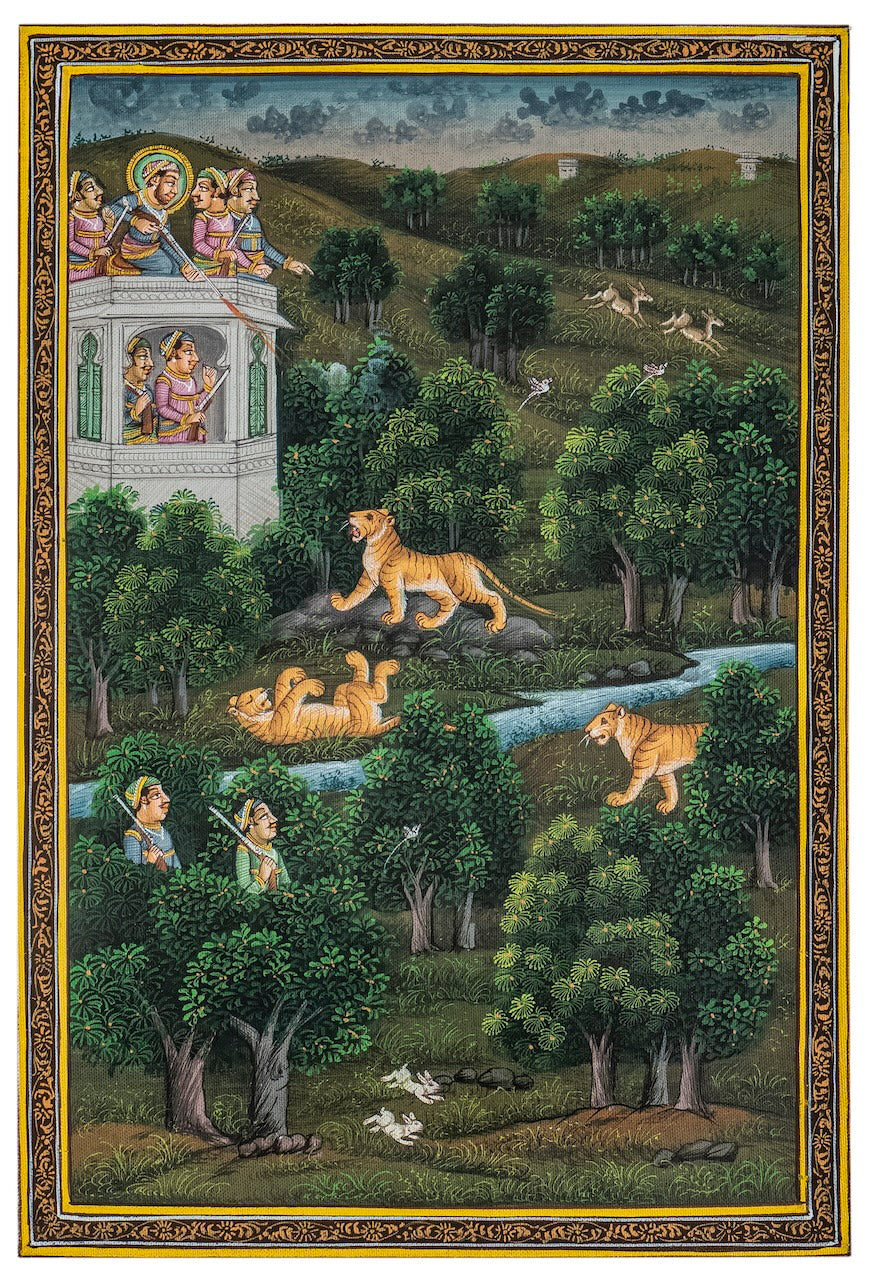
Royal Tiger Hunt In Forest Miniature Cloth Painting
Product details
Painting Details
| Tradition | Traditional Indian Miniature Painting |
| Region | Rajasthan, India |
| Medium | Hand-painted natural pigments on cloth base |
| Canvas preparation | Traditional cloth preparation with layered hand-finished surface |
| Pigments | Forest green, ivory white, slate grey, mustard gold, earthy brown, saffron orange, soft blue, and natural detailing pigments |
| Outline technique | Fine hand-drawn miniature detailing using precision brushwork |
| Originality | Original hand-painted artwork - not a print or reproduction. Created and detailed entirely by the artist by hand. |
| Year | 2026 |
| Subject | Royal tiger observation scene featuring noble figures viewing wildlife from a palace pavilion amidst a lush forest landscape |
| Framing | Unframed- Rolled Canvas |
Canvas Size & Dimensions
What's Included
- Original hand-painted miniature artwork— securely packed for safe handling and premium presentation
- Certificate of Authenticity— issued by ARTHENIC with artwork title, artist details, dimensions, and authenticity confirmation
- Artist Story Card— featuring the journey and artistic background of the artist
- Care & Display Guide— instructions for maintaining, framing, and preserving the artwork
- Premium protective packaging— designed to preserve delicate hand-painted detailing during transit
- ARTHENIC authenticity documentation— ensuring originality and collectible value of the artwork
Artisan Impact
Rajasthan's miniature painting tradition has long celebrated royal history, heroic narratives, and the grandeur of courtly life. Through generations of artistic mastery, miniature painters have preserved stories of kings, nobles, wildlife, and nature using intricate brushwork and extraordinary attention to detail.
Care & Display
Avoid direct sunlight to maintain the richness of colors.
Clean gently with a soft dry cloth or brush.
Keep away from moisture and damp walls.
Use premium framing with protective glass for long-lasting preservation.
Best suited for indoor decorative display in living rooms, studies, offices, libraries, heritage-inspired interiors, and luxury hospitality spaces.
Handle with clean, dry hands while installing or reframing.
Shipping & Returns
The artist
Neeraj Bhanawat has been connected to art since childhood. Through years of dedication, observation, and emotion, he built a world where every brushstroke speaks quietly yet deeply. His paintings carry patience, sensitivity, and timeless Indian heritage in every detail. For Neeraj, art became more than expression - it became his language, identity, and lifelong devotion.
Through intricate miniature detailing and timeless compositions, Neeraj continues to preserve the soul of traditional Indian art while creating pieces that feel intimate, emotional, and profoundly human.
Each artwork he creates carries a certain stillness - a silence that speaks through color, texture, and detail, making every painting feel alive beyond the canvas.
How it's made
A timeless miniature tradition, painted with patience and precision
This artwork is created through detailed hand-painting techniques inspired by traditional Indian miniature art. Every element - from the architectural detailing to the expressions, textiles, and landscape - is carefully painted by hand using fine brushwork and layered color application. The process reflects years of artistic discipline, where patience, control, and intricate detailing come together to create a composition rich in heritage, storytelling, and emotion.
-
1
Canvas preparation
The cloth surface is carefully prepared and treated to create a smooth painting base suitable for detailed miniature artwork. This preparation allows the fine brush detailing and layered colors to appear sharp, refined, and long-lasting.
-
2
Detailing & brushwork
Every figure, ornament, textile pattern, and architectural detail is painted manually using precision miniature techniques. Fine lines, delicate expressions, and decorative motifs are created through slow and controlled brush movements.
-
3
Color layering & finishing
Multiple layers of colors and detailing are added gradually to build depth, richness, and visual balance. The final artwork is carefully finished to preserve the elegance, texture, and timeless feel of traditional Indian miniature painting.
The story in the subject
A Royal Encounter with the Wilderness
This painting captures a tranquil yet captivating moment in which members of a royal household observe majestic tigers roaming freely within a dense forest landscape. Unlike dramatic hunting scenes often found in royal miniature paintings, this composition focuses on admiration, observation, and the harmonious coexistence of humans and nature.
Positioned within an elegant palace pavilion, the royal figures gaze toward the wilderness, creating a visual dialogue between refined courtly life and the untamed beauty of the natural world. The elevated architecture offers both a physical and symbolic perspective, emphasizing the fascination that rulers historically held for wildlife and their surrounding landscapes.
The composition unfolds through layers of lush vegetation, winding water channels, rolling hills, and carefully placed wildlife. The tigers emerge as symbols of strength, dignity, and natural power, while the surrounding scenery evokes serenity and balance. Every detail has been meticulously rendered to create depth, movement, and a sense of timeless storytelling.
The artwork embodies the essence of traditional Indian miniature painting, where nature is not merely a backdrop but an active participant in the narrative. Through intricate brushwork and delicate coloring, the artist transforms a simple moment of observation into a celebration of beauty, curiosity, and cultural heritage.
Key Elements of the Composition The palace pavilion
The elegant pavilion represents royal refinement and serves as the viewing point from which the nobles observe the surrounding landscape.
The tigers
The majestic tigers symbolize courage, strength, and the untamed spirit of nature, becoming the focal point of the composition.
The forest landscape
Dense foliage, layered vegetation, and natural pathways create depth while emphasizing the richness of the wilderness.
The flowing stream
The gentle watercourse introduces balance and tranquility, connecting various elements throughout the composition.
The royal observers
The noble figures represent curiosity, appreciation of nature, and the traditional relationship between royal courts and the natural world.
The distant hills
The rolling landscape expands the visual narrative beyond the foreground, adding atmosphere, scale, and a sense of timeless serenity.
Frequently asked